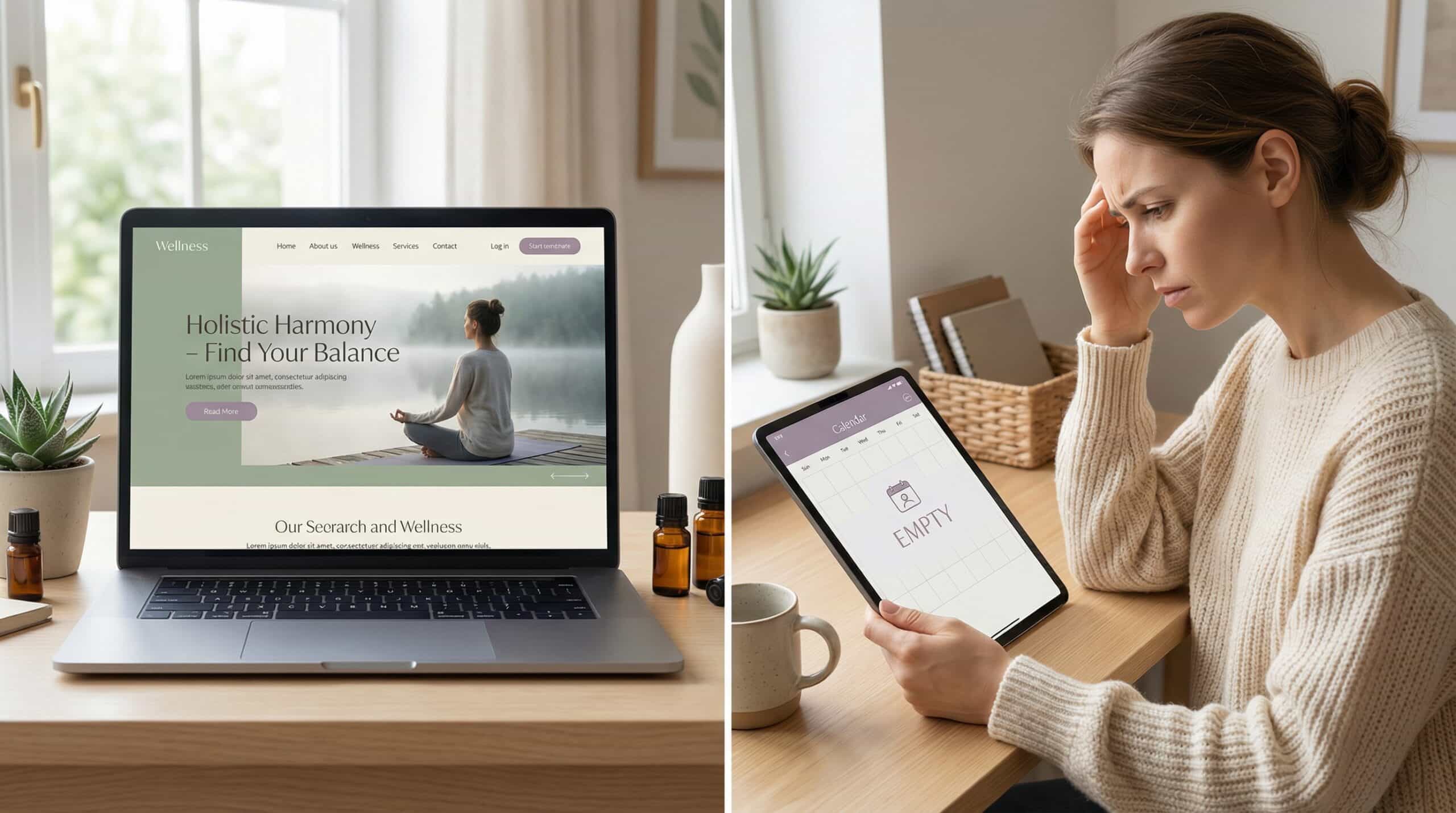
If you are a holistic or integrative medicine practitioner, chances are you already have a website.
It probably looks calm.
It might use soft colors, nature images, and words like healing, balance, and transformation.
You may even get compliments like, “Your website is beautiful.”
And yet…
Your calendar still has gaps.
New client inquiries feel inconsistent.
Referrals help, but they are not predictable.
This is far more common than most practitioners realize.
And it has nothing to do with the quality of your care.
The Hard Truth Most Practitioners Are Never Told
A good-looking website is not the same as a working website.
Most wellness websites are built to express a philosophy, not to guide a decision.
That makes sense.
You are a healer, not a marketer.
But online, your website has one main job:
to help the right person feel safe, understood, and confident enough to take the next step.
When that does not happen, the website quietly fails, even if it looks beautiful.
The 6 Reasons Most Wellness Websites Do Not Convert
1. There Is No Clear Next Step
Many holistic websites explain what you do but never clearly guide the visitor.
People are left wondering:
Should I book something now?
Should I keep reading?
Should I come back later?
When the path is unclear, even interested people hesitate.
And hesitation online usually means leaving.
A calm website still needs gentle guidance.
2. Trust Is Assumed Instead of Built
You know your work is powerful.
Your clients know it too.
But a new visitor does not.
Many websites skip the early trust-building step and move straight into services or philosophy.
In holistic care, trust comes before action.
If your website does not build trust early, people may appreciate your work but still not reach out.
3. The Message Is Too General
Words like holistic, natural, integrative, and transformational matter deeply.
But they are also used everywhere.
Many websites sound good but could belong to almost anyone.
Your ideal client is not looking to be impressed.
They are looking to feel understood.
Specific struggles create connection.
Clear language creates relief.
4. Interest Has Nowhere to Go
This is one of the most overlooked issues.
Many visitors are curious but not ready.
They want to explore, feel things out, or stay connected without making a commitment yet.
When a website only speaks to people who are ready right now, it quietly ignores everyone else.
Those visitors often leave thinking, “This feels aligned, but maybe later.”
And later rarely comes without support.
A working website makes room for curiosity, not just decisions.
5. There Is No Follow Up System
Even when someone feels aligned, life happens.
They get interrupted.
They get busy.
They forget to come back.
Without a gentle way to continue the conversation, those visitors are lost.
This is not about pressure.
It is about presence.
Most practitioners lose far more potential clients here than they realize.
6. Local Visibility Is Weak or Inconsistent
A website does not exist on its own.
If search engines do not clearly understand who you serve, where you serve, and why you matter, your website struggles to be seen.
Many practitioners rely on referrals alone or assume their website will eventually be found.
Visibility is not automatic.
It is intentional.
Without it, even the most aligned website stays quiet.
Why This Feels So Frustrating
What makes this especially frustrating is that none of these issues mean your practice is doing something wrong.
They reflect a gap between how healing relationships are built in real life and how most websites are designed to function online.
In person, you listen.
You respond.
You meet people where they are.
Most websites do not do that by default.
And when that gap is closed thoughtfully, without pressure or complexity, the experience of being found online can begin to feel supportive instead of draining.
What a Wellness Website Should Actually Do
A website for holistic and integrative practitioners should:
- Help the right people feel understood
- Build trust gently and clearly
- Show credibility without ego
- Capture interest without pressure
- Support follow up without overwhelm
This is not about tricks or trends.
It is about clarity and alignment.
When done right, your website becomes a quiet partner in your practice, working even while you rest.
You Do Not Need More Tools. You Need the Right Structure.
Most practitioners do not need:
More platforms
More posting
More complicated systems
They need:
A clear message
Local visibility
A simple path to connection
A system that supports human care, not replaces it
That is the difference between a website that looks good and one that actually helps people find you.

A Gentle Next Step
If you are not sure why your website is not bringing the clients you want, you are not alone.
Sometimes the issue is small.
Sometimes it is structural.
Either way, clarity helps.
You can book a strategy call to talk through what may be holding your visibility back.
Or you can request a free visibility audit to see how your website and local presence are really performing.
No pressure.
Just insight and direction.
Your work matters.
Your website should support it.