Is Your Wellness Practice Invisible to ChatGPT? The New Rules of Getting Found by AI
A prospective client used to start with a Google search and a list of ten results to sort through. Now they’re just as likely to open ChatGPT or Perplexity and ask a direct question: “Who’s a good hypnotherapist near Denver for anxiety?” The assistant doesn’t hand back a list. It names a practice, maybe two, and the search is over before it really starts.
If your practice has never come up in one of those answers, that’s not a sign you’re behind. Most practitioners haven’t checked yet, because this shift happened faster than the marketing advice around it. For a referral-dependent practice, it’s worth a few minutes of attention, since it’s quietly becoming another way clients find you before they ever land on your website. What’s worth understanding is what actually earns that recommendation. It’s simpler than it sounds, and it overlaps almost entirely with the visibility work that already matters for your practice.
The Search Box Isn’t the Only Way In Anymore
When someone asks an AI assistant directly, it doesn’t return a page of options to weigh. It picks. SOCi’s 2026 Local Visibility Index found that ChatGPT names a specific business only a small fraction of the time it’s asked, well below how often a business appears in Google’s own local map results. Being the name an assistant chooses is a narrower door than ranking reasonably well in a traditional search.
That narrower door changes what “good enough” looks like. A practice can do fine in Google’s map pack and still never come up when a prospective client asks an assistant by name. The two aren’t the same achievement, and treating them as interchangeable is how a solid local presence quietly stops translating into new inquiries. It’s less about chasing a new channel and more about noticing where your existing visibility work already stops short.
What Actually Earns the Recommendation
AI assistants don’t have private insight into your practice. They assemble an answer from whatever public information is complete and consistent enough to trust. Four things tend to matter most, and they’re the same four things worth getting right regardless of who, or what, is doing the searching.
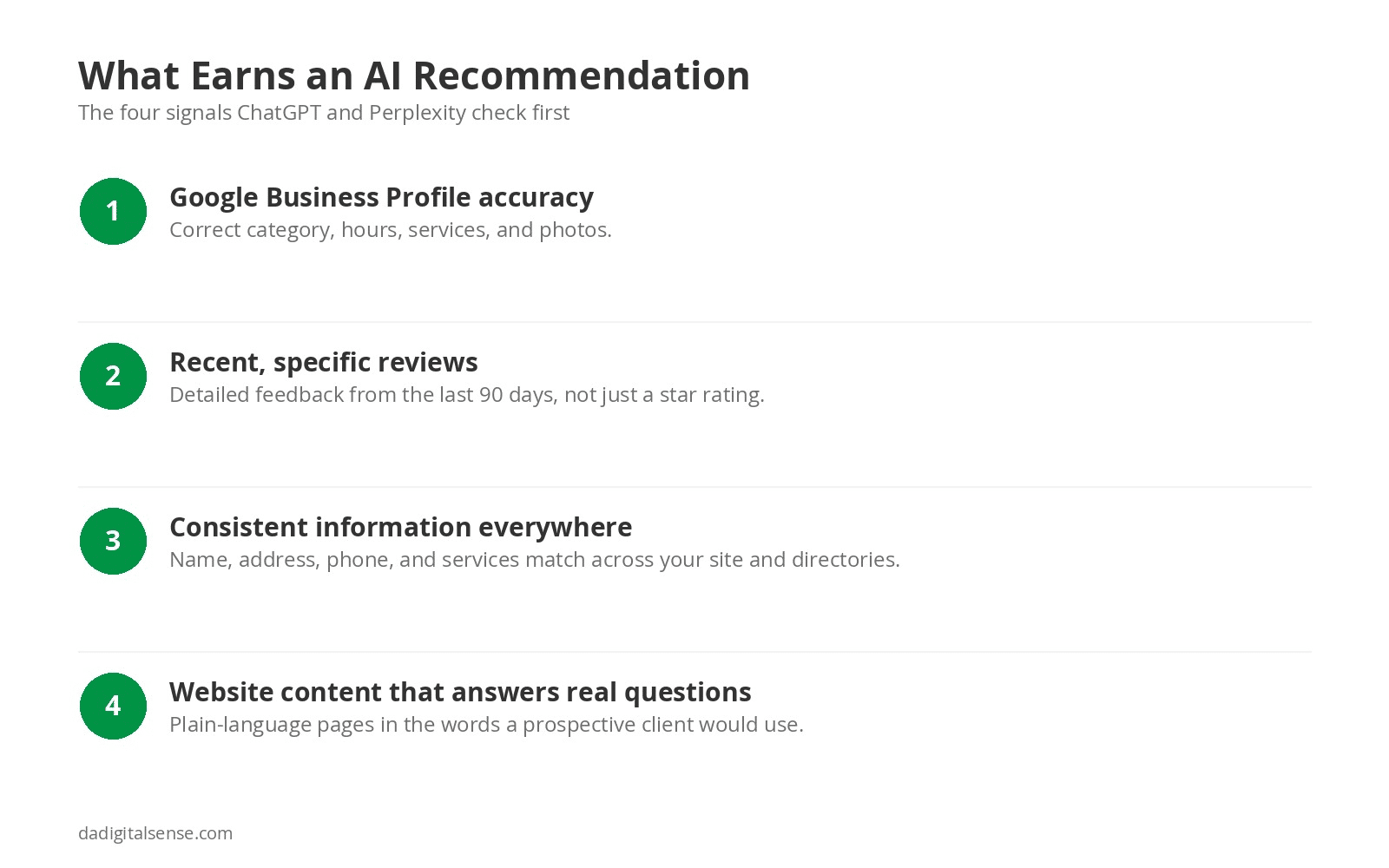
Most of that will look familiar, because it’s the same foundation that’s driven local search for years. The one wrinkle specific to health and wellness: Google’s own AI summaries mostly stay out of “near me” provider searches like “hypnotherapist near me” or “massage therapist near me,” according to BrightEdge’s healthcare AI search research. For now, it’s the standalone assistants, not Google’s own results page, doing most of the direct recommending for provider searches like these. That’s a reason to take them seriously on their own terms, not just as an extension of regular Google SEO.
A Two-Minute Way to Check Where You Stand
Before spending money on anything, it’s worth finding out where you actually stand. Open ChatGPT or Perplexity and ask the question a prospective client would ask: “Who’s a good [your modality] in [your city]?” Then look at a few things.
Does your practice show up, and is the information accurate? Is your Google Business Profile category the closest possible match to what you actually do? Modalities that don’t fit neatly into Google’s categories, like energy work or hypnotherapy, often disappear from these answers simply because the closest available category doesn’t describe what the practice actually offers. Have you had specific, detailed reviews in the last 90 days, not just a decent star rating? And does your website explain your services in the words a client would actually use, rather than mostly describing your philosophy?
A gap in any of those is usually the real reason you’re missing from these answers. It’s rarely a lack of AI-specific technical work, and it’s almost never something only an expensive new tool can fix. If you show up but the details are wrong, that’s a fast fix. If you don’t show up at all, it usually points to one of those four areas being thin enough that an assistant couldn’t find anything confident to say about you.
Why This Isn’t a New Marketing Project
At DaDigitalSense, we build exactly these signals for holistic and integrative practices: an accurate Google Business Profile, active local SEO, and a steady flow of specific, recent reviews. When that foundation is solid, AI visibility tends to follow it, because assistants are reading the same information everyone else is. When it isn’t, the fix usually isn’t more marketing. It’s cleaning up what’s already public.
One hypnotherapy practice we worked with moved from page four to page one of Google for “Hypnotherapy” in her area after we rebuilt her Google Business Profile and local SEO foundation. That’s the same foundation this article is describing, just measured by a different search engine. If your profile hasn’t been touched in a while, our 7-step GBP revival plan is the more concrete next step, since a stale profile holds back your regular Google visibility and your AI visibility at the same time.
Not Sure Where Your Practice Actually Stands?
| A focused look at your Google Business Profile, reviews, and website content will tell you more in a few minutes than any guess about “AI SEO.” Get a free visibility audit and see exactly what’s worth fixing first. |