
The 5-Layer AI Visibility Stack Every Holistic Practice Needs in 2026
If you’ve already put work into local SEO, that’s a real head start, but AI assistants don’t read your visibility the same way Google’s map results do. A practice can rank respectably in local search and still never get named when someone asks ChatGPT or Perplexity for a recommendation, because those tools are reading a narrower, more specific set of signals.
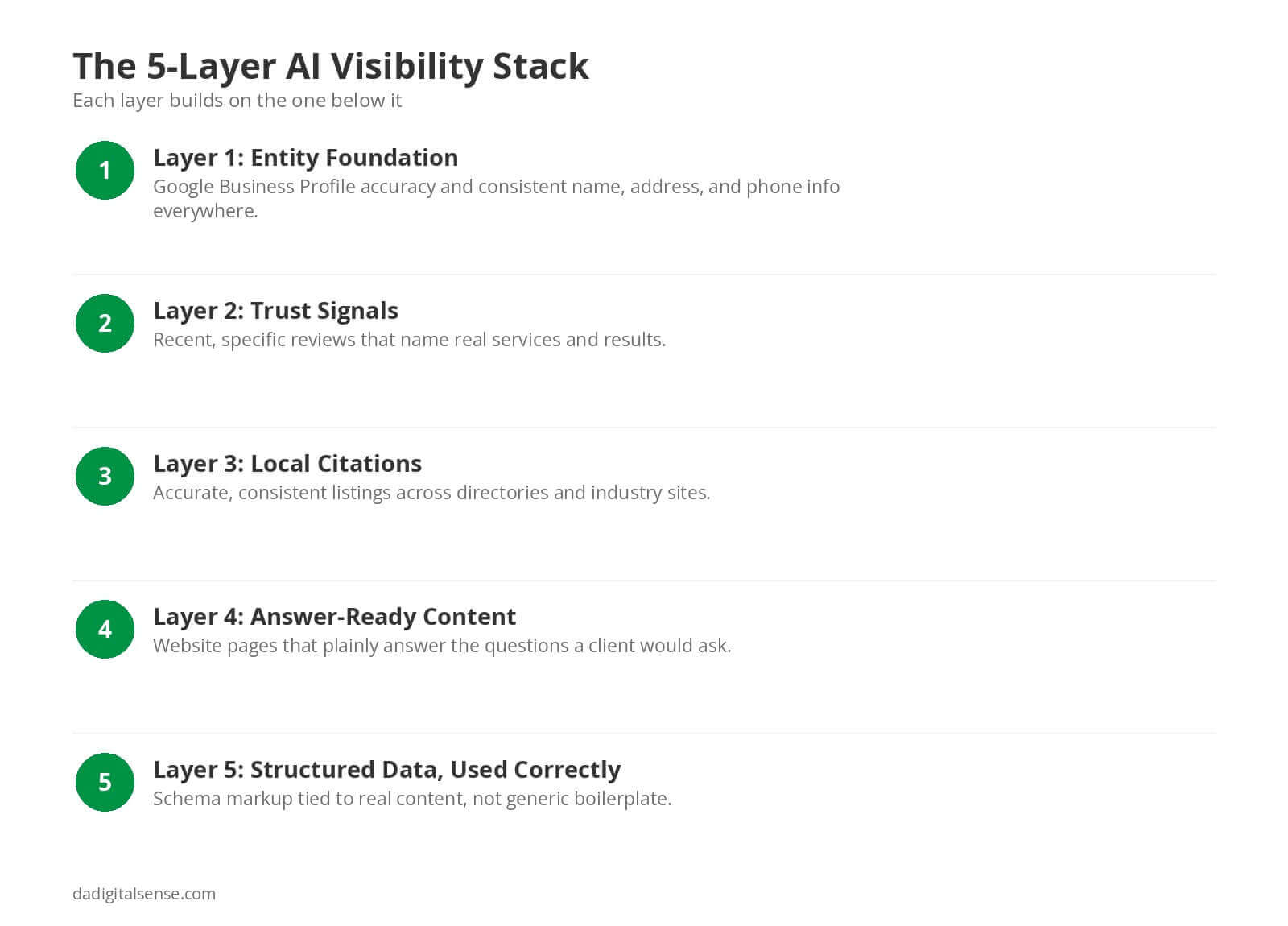
Most advice treats this as one more checklist. It’s more useful to think of it as a stack: five layers, each one built on the layer below it, each doing a different job. If one layer is thin, the layers above it don’t matter much, no matter how much time you’ve put into them. A practice with a beautiful website and no consistent citations, or glowing reviews and an outdated Google Business Profile, is still missing pieces an AI assistant needs before it will vouch for you. Knowing which layer is weak, instead of guessing, is most of the work.
Layer 1: Your Entity Foundation
Everything else depends on this layer. An AI assistant needs to be confident about who you are, what you do, and where you’re located before it will recommend you at all. That confidence comes from your Google Business Profile and how consistently your name, address, phone number, and services appear everywhere else you’re listed.
Gaps here are common and easy to miss: an outdated category, a phone number that doesn’t match across directories, or services listed on your website that don’t match what your profile says. None of that stops a determined client from finding you. It does make an AI system less certain you’re a safe answer to give, and uncertainty is usually resolved by leaving a practice out rather than risking a wrong recommendation.
Layer 2: Trust Signals
Once an assistant is confident you exist and do what you claim, it looks for evidence that you’re worth recommending. Reviews are the clearest version of that evidence, but not just any reviews. Recency and specificity carry more weight than volume. Reviews that name a real service or a real result read as more credible than a high star rating with generic comments, and stale reviews (nothing in the past few months) read as a practice that may have gone quiet. Our guide to managing online reviews covers how to keep this layer active without it becoming another task you never get to.
Layer 3: Local Citations
Citations are the mentions of your practice across directories, associations, and other sites, and they’re the layer most practices never audit. Inconsistent or outdated citations don’t just confuse search engines. They give an AI assistant conflicting information to reconcile, which often means it skips you rather than risk recommending the wrong details. Our guide on using local citations to improve SEO walks through what to check first and where the highest-value citations tend to sit for wellness practices.
Layer 4: Answer-Ready Content
Your website earns its place in this stack when it actually answers the questions a prospective client would ask, in the words they’d use. A services page that describes your philosophy at length but never says what a session costs, how long it runs, or what conditions you commonly treat, gives an AI system very little to extract and repeat with confidence. A page that plainly states “60-minute sessions, in-person and virtual, for stress, sleep, and anxiety support” gives it something concrete to work with. Specific, plain-language content is what gets pulled into an answer.
Layer 5: Structured Data, Used Correctly
Schema markup is the layer everyone asks about first, and the one most often applied wrong. A 2026 review of conflicting industry studies found that generic, boilerplate schema (the kind most website builders add automatically) produced little to no increase in AI citations on its own. The studies that found real gains applied schema to genuinely detailed, question-and-answer style content, not to pages that were thin to begin with. In other words, schema can help the layers below it get read correctly. It can’t substitute for them.
Building the Stack, Not Just One Layer
Practices rarely have a full stack in place. Most have built up one or two layers, usually a decent website and maybe a Google Business Profile, while citations sit untouched and reviews go stale. That imbalance is exactly why AI visibility can feel unpredictable: you may be strong in the layers you can see and thin in the ones you’ve never checked, since citations and structured data rarely get looked at until something prompts the question.
This is the same work we do for holistic and integrative practices at DaDigitalSense, layer by layer rather than as a single project. We typically start wherever the foundation is weakest, since fixing Layer 5 while Layer 1 is inconsistent rarely moves the needle. One wellness practice we worked with had us rebuild their SEO foundation and optimize their Google Business Profile together, and their own words afterward were that it “put us on the map.” That’s Layers 1 through 3 working as a set, not any single tactic in isolation.
Not Sure Which Layer Is Thinnest?
| A short audit will tell you faster than guessing. Get a free visibility audit and see exactly where your five layers stand. |