
If “send more emails” is on your marketing to-do list, but every draft feels awkward, you are not alone.
Most wellness practitioners did not build their work around urgency, pressure, or constant promotion. You built it around attention, trust, and helping people make decisions at a pace that feels right for them. So when traditional marketing advice tells you to “create a scarcity campaign” or “push the offer,” it can feel like you are being asked to trade your values for growth.
You do not have to.
A thoughtful email sequence is not a substitute for care. It is a way to extend clarity between appointments, answer the questions people are already carrying, and make the next step easier when someone is ready. The difference between nurturing and selling is not whether you ever invite someone to book. It is whether every message earns that invitation.
Why Email Can Feel More Personal Than Posting Every Day
Social media asks people to find you again and again. An email sequence gives a prospective or past client a quieter place to learn from you over time.
That does not mean your emails need to become mini treatment sessions. For covered healthcare practices, email communication requires appropriate safeguards, and individualized health information should not be placed in a general automated sequence.[1] But a well-designed series can still offer useful education, orient someone to your process, and answer common non-personal questions.
The real value is consistency. Instead of trying to remember every follow-up after a discovery call, download, inquiry, or session, you decide once what a helpful next step looks like. The system handles the timing; you remain present where a human response is needed.
The Reframe: Build a Welcome Path, Not a Sales Funnel
The word “funnel” can make a heart-centered practitioner cringe. It sounds like a machine designed to force people toward a purchase.
Try thinking of it as a welcome path instead.
A good welcome path has three jobs:
- Orient: Help a new person understand what your practice offers and whether it may be a fit.
- Reassure: Answer the questions that create hesitation before a first session.
- Invite: Offer a clear next step without making someone feel chased.
That is the same work you already do in a thoughtful first conversation. An email sequence simply makes it available before someone has the confidence to reply or book.
The Five Emails That Do the Most Work
You do not need a 27-email sequence. Start with five emails that each have one clear purpose.
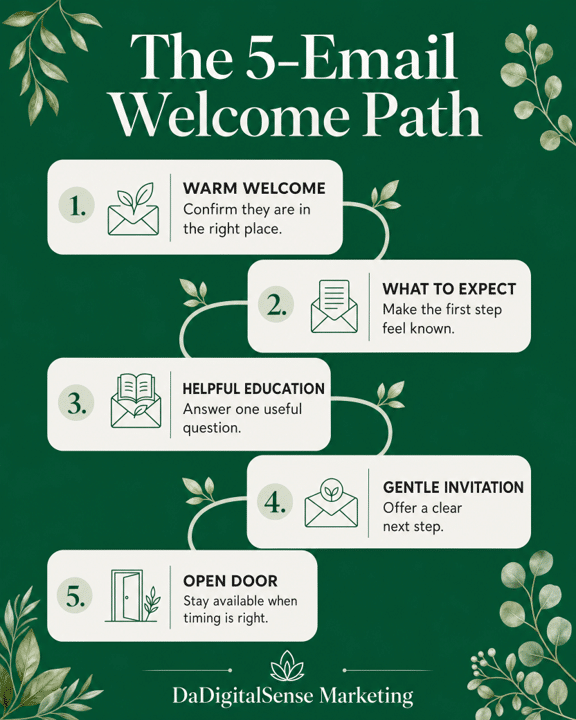
Email 1: The warm welcome
Send: Immediately after someone joins your list, downloads a resource, or submits an inquiry.
Purpose: Confirm they are in the right place and set expectations.
This email should sound like a real person wrote it. Thank them for reaching out, briefly explain what they can expect from your emails, and name one helpful resource or next step.
For example: “Over the next few weeks, I’ll share a few practical ways to understand how I work, what a first session looks like, and how to decide whether this approach is right for you.”
Avoid using the first email to introduce every service, credential, and offer. The goal is simple: reduce uncertainty and welcome the person in.
Email 2: The “what to expect” note
Send: Two to three days later.
Purpose: Make the first step feel less unknown.
Many prospective clients are not deciding whether they need support. They are deciding whether it will feel safe, understandable, and manageable to begin.
Explain your process in plain language. What happens in a first session? How long is it? Do they need to prepare? What questions can they ask before booking? This is practical content, but it is also trust-building content.
If your booking process or follow-up flow is inconsistent, this is a good place to review your broader automated client follow-up system. A clear email cannot compensate for a confusing or slow response once someone is ready to engage.
Email 3: One useful piece of education
Send: Four to six days after the welcome.
Purpose: Demonstrate how you think without turning your inbox into a lecture.
Choose one question clients ask repeatedly. It might be “How do I know if this approach is right for me?” or “What is the difference between relaxation massage and therapeutic massage?” Give a short, grounded answer. Link to a blog post or guide only if it offers a real next layer of value.
The aim is not to prove that you know everything. It is to give someone an experience of your clarity and care.
Email 4: A gentle invitation
Send: About one week later.
Purpose: Make the next step obvious.
This is where many practitioners either disappear or overcorrect. Some never make an offer because they do not want to be pushy. Others suddenly shift into discount language that does not match the rest of their communication.
A better invitation is specific and calm: “If you would like to talk through whether this is a fit, you can book a consultation here.” You can name what the person will receive from that conversation and let the invitation stand on its own.
No countdown timer is required. No manufactured urgency is needed.
Email 5: The open door
Send: Seven to 10 days after the invitation.
Purpose: Keep the relationship warm without repeating the pitch.
Acknowledge that timing matters. Invite a reply with a low-pressure question, such as, “What is the biggest question you still have about getting started?” Or share a brief reminder that the resource is available whenever they are ready.
This email often earns replies because it makes space for uncertainty instead of pretending it does not exist.
Build Sequences Around Real Moments, Not a Generic Calendar
The strongest client nurture sequence is tied to what a person has actually done. A new inquiry needs different support than a past client who has not booked in six months.
Start with one audience and one moment:
- A person who completed a website form but did not book.
- A new email subscriber who downloaded a guide.
- A client who has just finished an initial session.
- A past client who may benefit from a gentle reconnection.
For the last group, a separate reactivate past clients campaign may make more sense than dropping everyone into the same welcome series. The purpose determines the message, the timing, and the invitation.
Three Ways to Keep Automation Human
Automation becomes impersonal when it ignores context. Keep your sequence aligned with your values by following three rules.
Write as if one person will read it. Use language you would comfortably say in a consultation or at the front desk.
Ask for one action at a time. An email can ask the reader to read a guide, reply to a question, or book a session. It does not need to do all three.
Make it easy to reach a person. If someone replies, their message should go somewhere that receives a timely human response. Automation should create room for connection, not a dead end.
Start Small, Then Improve from Real Replies
You do not need a complicated platform or a perfect map of every client scenario to begin. Create the five-email sequence for your most common first step. Send it to yourself. Read it aloud. Remove anything that sounds like a script someone else told you to use.
Then pay attention to the replies and questions that come back. They tell you where people are confused, what they need to hear earlier, and where your next email or website update should focus.
That is ethical nurture marketing: not trying to convince everyone, but making it easier for the right people to understand their options and take a supported next step.
Want help turning your follow-up into a calm, consistent system? Book a Strategy Session.