
You know the questions by heart. “Does insurance cover this?” “What should I expect during my first session?” “How many treatments will I need?”
As a holistic practitioner, you answer these questions in the clinic, over the phone, and in emails every single week. But if those answers only live in your head or in private conversations, you are missing one of the most powerful visibility opportunities in modern search.
When a potential client in your city asks ChatGPT, Perplexity, or Google’s AI Overview a specific question about your modality, those AI engines don’t read websites like humans do. They look for structured, authoritative answers they can extract and cite.
Your FAQ page shouldn’t just be a customer service tool. When structured correctly, it becomes a silent referral engine that feeds your expertise directly into AI search results.
Why AI Search Engines Love FAQs
The way people search for holistic care is changing. Instead of typing “acupuncture near me,” they are asking conversational questions like, “What is the best holistic treatment for chronic migraines in Denver?”
AI search engines generate responses by synthesizing information from multiple sources. To do this accurately, they actively look for content that is already formatted as a question and a concise answer.
According to recent research on Generative Engine Optimization (GEO), content structured with clear question-answer formats receives significantly more visibility in AI-generated responses than unstructured paragraphs covering the same topic.
AI models prefer FAQ content because it is:
- Question-aligned: It explicitly matches the user’s query.
- Concise: It is short enough to extract and quote directly.
- Self-contained: The answer makes sense without needing the surrounding paragraphs.
When your website provides these clear, self-contained answers, you make it incredibly easy for AI to cite your practice as the local authority.
The Invisible Code: FAQ Schema Markup
Having an FAQ page is the first step, but how you build it matters just as much as what you write. This is where FAQ Schema Markup comes in.
Schema markup is a type of structured data — invisible code added to your website — that explicitly tells search engines, “This specific sentence is a question, and this specific paragraph is the authoritative answer.”
While Google recently restricted how often FAQ rich results appear in traditional search, FAQ schema has emerged as one of the most critical signals for AI search visibility. It removes the guesswork for AI crawlers. Instead of forcing the AI to parse a long blog post to find an answer, schema hands the AI the exact answer on a silver platter.
If your website platform allows it, adding FAQ schema to your service pages and dedicated FAQ sections is one of the highest-leverage technical updates you can make for your practice.
How to Write FAQs That Get Cited (and Convert)
You don’t need to write a textbook to be cited by AI. In fact, writing too much can actually hurt your chances of being extracted. Here is how to structure your answers for maximum visibility and trust.
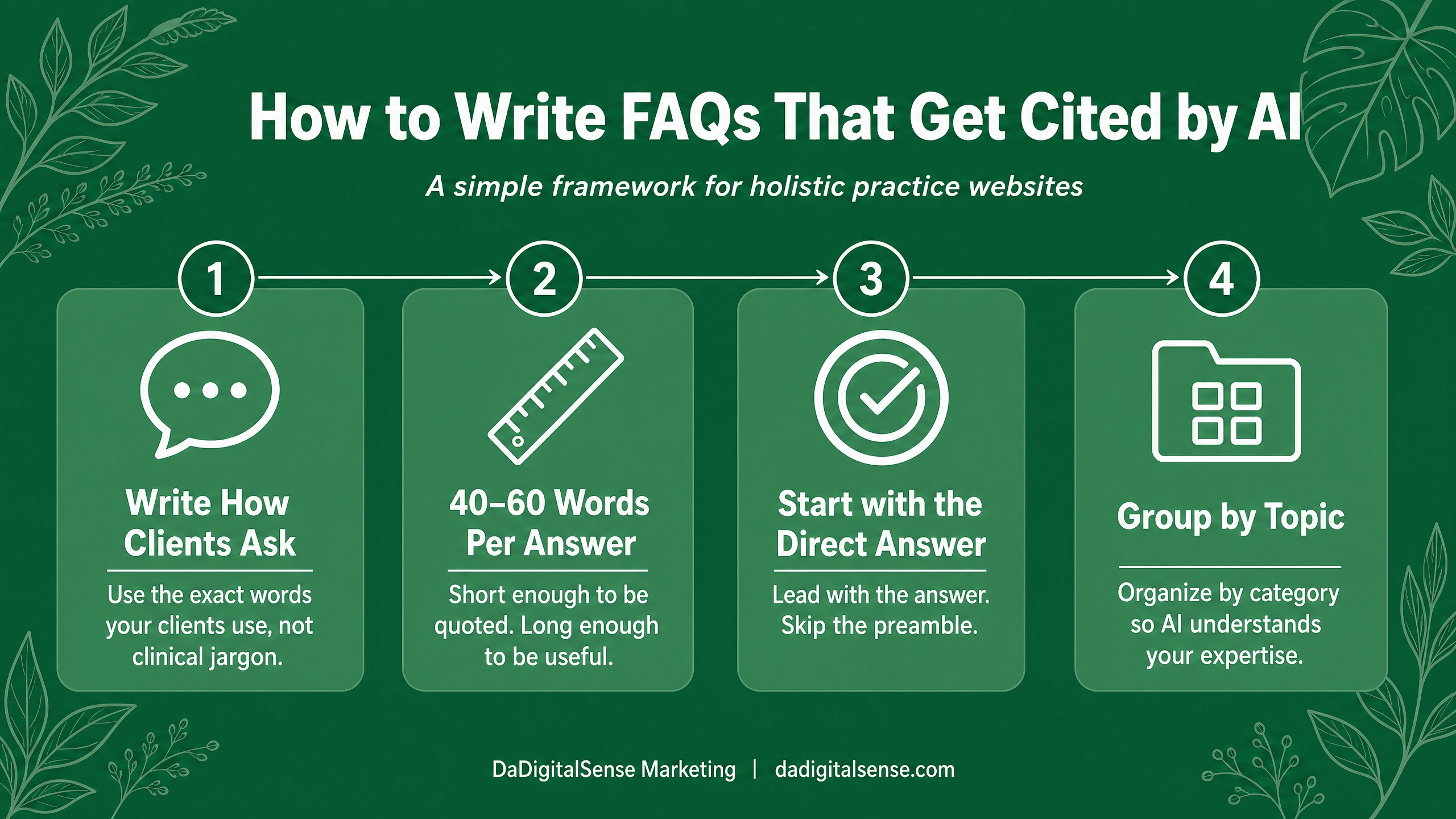
-
Write Questions Exactly How Clients Ask Them
Do not use internal clinical jargon for your questions. If your clients ask, “Does dry needling hurt?” use that exact phrasing. Do not change it to “Sensory Expectations During Intramuscular Stimulation.” AI matches user queries to your content, so mirror the language your community actually uses.
-
Keep Answers Between 40 and 60 Words
This is the sweet spot for AI extraction. It is long enough to provide a complete, useful answer, but short enough to be quoted in full. If a topic requires a 500-word explanation, write a brief 50-word summary for the FAQ, and link to a dedicated blog post for the deep dive.
-
Start with a Direct Statement
Do not start your answers with filler like, “That is a great question, and it depends on many factors.” Start with the direct answer.
Example: “Most clients experience mild soreness for 12 to 24 hours after a deep tissue massage, followed by significant relief in muscle tension.”
-
Group by Topic, Not Randomly
Organize your FAQs logically (e.g., “About the Treatment,” “Booking & Insurance,” “What to Expect”). This topical grouping helps AI models understand the breadth of your expertise and makes it easier for human readers to navigate.
Stop Answering the Same Questions in Private
Every time you type out a thoughtful, detailed answer to a prospective client’s email, you are creating valuable content. But if you only send it to one person, its lifespan ends there.
By moving those answers to a structured, schema-optimized FAQ page, you turn a repetitive administrative task into a permanent marketing asset — the kind of evergreen content that builds trust long after you’ve written it. You educate your community, build credibility before they ever step foot in your clinic, and position your practice to be cited by the next generation of search engines.
If you aren’t sure whether your current website is structured to capture these AI search opportunities, or if your local visibility has stalled, we can help you diagnose the bottleneck.
| Ready to transform your online presence? Book a Free Visibility Audit today. |