
If your practice has moved offices, changed its name, swapped phone numbers, or added a practitioner in the last few years, there’s a good chance your business information doesn’t match everywhere it appears online. Most owners never think about this until a patient mentions calling an old number, or a new client says they almost went to the wrong address. It rarely feels urgent, because your website is usually fine and your Google Business Profile looks correct.
The problem is what’s happening in the background. Search engines and AI assistants don’t just read your website. They cross-reference your name, address, and phone number (often shortened to NAP) across dozens of directories, review sites, and data sources to decide whether they’re confident enough in who you are to recommend you. When those details don’t line up, that confidence drops, quietly, before you’d ever notice a problem.
What NAP Consistency Actually Means
NAP consistency isn’t about every listing being character-for-character identical. “Rd.” instead of “Road,” or “Ste.” instead of “Suite,” rarely causes trouble; most platforms normalize small formatting differences on their own. What matters is that your core identity, your official business name, your primary address, and one main phone number, stays stable and matches across the places that carry weight: your website, your Google Business Profile, major directories, and any site that lists local businesses in your field.
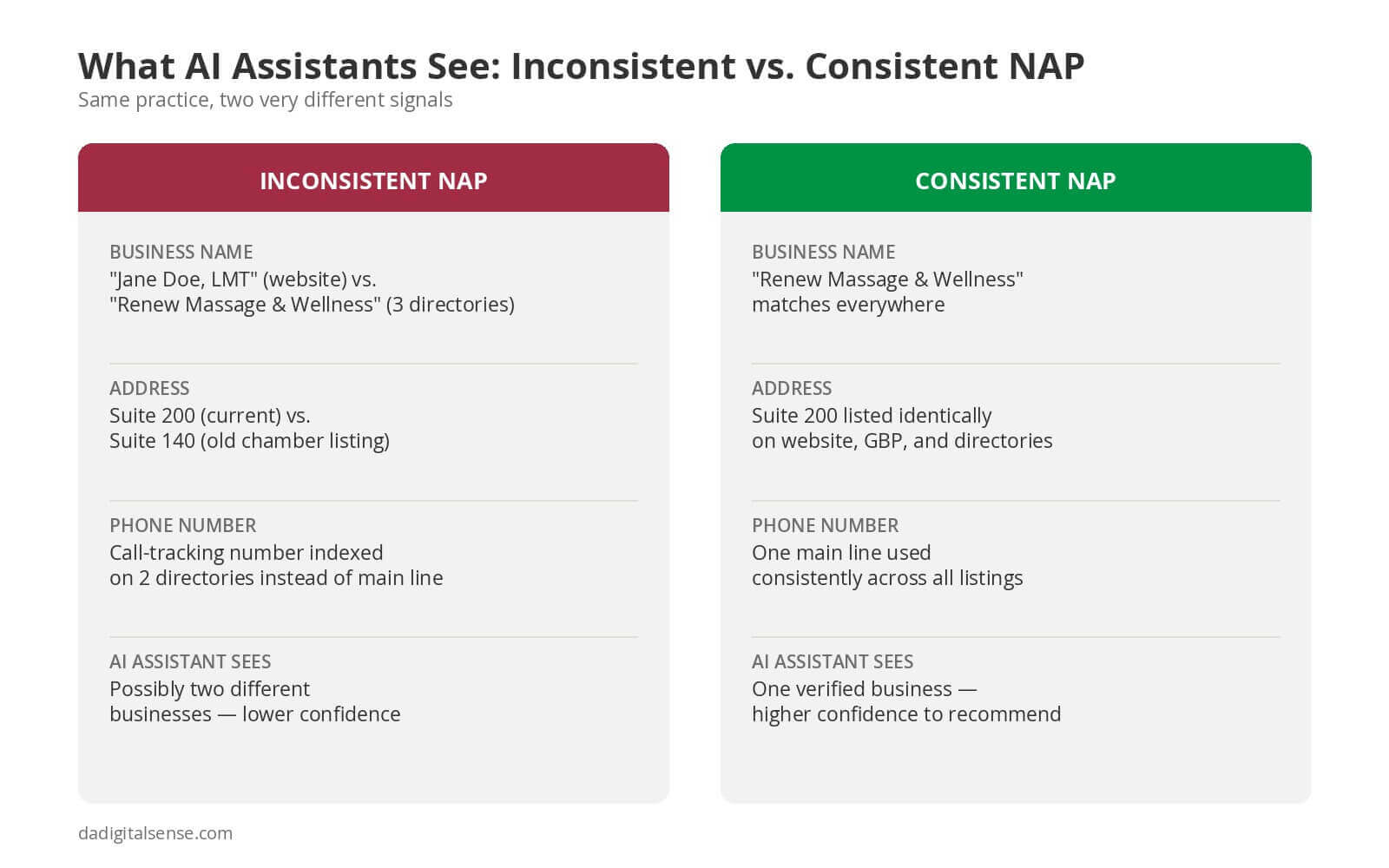
True inconsistency looks different: an old suite number still live on a chamber-of-commerce page, a call-tracking number indexed on a directory instead of your real line, or a practitioner’s personal listing competing with your practice’s listing. Those gaps are what create real problems.
Why AI Assistants Are Less Forgiving Than Google
Google has gotten reasonably good at reconciling small inconsistencies on its own, matching “Suite 200” to “Ste. 200” without much trouble. AI assistants work differently. When someone asks ChatGPT or Perplexity for “a massage therapist near me who takes evening appointments,” the assistant is pulling from multiple sources at once and trying to decide whether they all describe the same business. If your name, address, or phone number varies across those sources, the safer move for the assistant is to treat you as unverifiable, or worse, as two different businesses, and recommend a competitor with cleaner data instead.
This is the shift worth understanding: local rankings and AI visibility are two separate layers now. A practice can still show up respectably in Google’s local pack while quietly disappearing from AI-generated answers, simply because the assistant couldn’t confirm it was looking at one consistent business. A recent analysis of NAP consistency’s role in local SEO puts it plainly: inconsistent data creates friction at the exact moment these systems want certainty, and that friction is usually resolved by leaving the business out rather than guessing.
Where This Usually Breaks Down for Wellness Practices
A few patterns show up again and again in integrative and holistic practices specifically:
- A move that wasn’t fully updated. The website and Google Business Profile get the new address, but the old suite number stays live on a handful of smaller directories or a chamber-of-commerce page.
- A rebrand or name change. “Jane Doe, LMT” becomes “Renew Massage & Wellness,” but older listings, review platforms, and even old marketing materials still reference the individual practitioner’s name.
- Multiple practitioners under one practice. Each practitioner has a personal listing that competes with the practice’s main listing, splitting reviews and confusing which one is authoritative.
- A phone number left over from a previous system. Call-tracking numbers used for ads sometimes get indexed on directories in place of the real line, and nobody catches it until a patient can’t get through.
None of these happen out of carelessness. They happen because updating a website is a single task, while updating every directory, aggregator, and profile that mentions your practice is not something most software reminds you to do.
A Simple Way to Check Your Own Consistency
You don’t need a technical audit to get a rough read on where you stand. Search your practice’s name in a search engine and look at the first two pages of results, including directories, review sites, and any local business listings. Then check three things for each one: does the name match your current branding, does the address match your current location, and does the phone number match the line you actually answer. Anywhere you find a mismatch is a place an AI assistant or search engine could be reading conflicting information about your practice.
If you find more than one or two mismatches, or if you have multiple practitioners with separate listings, that’s usually a sign it’s worth a closer look rather than a one-off fix.
Fixing It Without a Full Overhaul
None of this requires rebuilding your online presence. It requires establishing one accurate version of your name, address, and phone number, and then correcting the places that don’t match it, starting with the highest-traffic directories and your Google Business Profile before moving to smaller listings. For practices with multiple practitioners, it usually means deciding which listing is authoritative and consolidating the rest.
This is part of why our Google Business Profile setup and optimization guidance for massage therapists treats accurate profile details as the starting point, not an afterthought, and why our local listing management service exists as its own workstream rather than a one-time setup task. One practice we worked with, an Integrative Wellness clinic, had us clean up and optimize their Google Business Profile alongside their broader visibility work. Their own description afterward was that we’d “revamped our SEO, optimized our Google Business Profile… put us on the map.” Consistent, accurate business data was part of what made that visible.
Not Sure Which Listings Are Telling One Story?
| A short audit will tell you faster than searching directory by directory on your own. |