
A five-star rating looks good. But for a local wellness practice, a rating alone does not tell a prospective client—or a search system—very much.
Someone comparing two practitioners may see that both have strong average ratings. What helps them choose is usually the detail: whether reviews are recent, whether they describe the experience clearly, and whether they make the practice feel current and trustworthy.
That is why reputation management is not a one-time project you finish after collecting a certain number of reviews. It is an ongoing part of how your practice is discovered and evaluated online.
Google says that complete, accurate business information and positive reviews can help a business stand out in local results. It also notes that reviews and ratings are part of the broader signals that can support local prominence.[1] AI assistants are not a new shortcut around that foundation. When they surface a local practice, they still need public information that is clear enough, current enough, and consistent enough to support an answer.
Why Review Recency Changes the Conversation
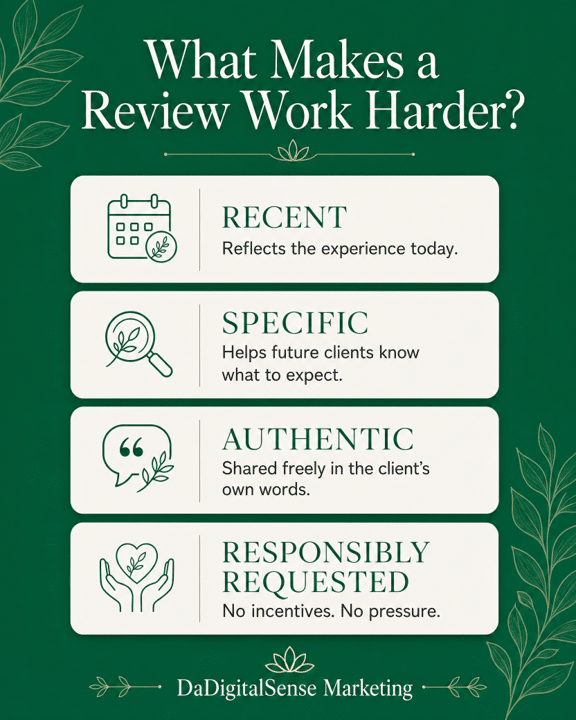
A review from three years ago can still be meaningful. It may reflect real care and a genuine client experience. But it cannot reassure a new visitor that the same experience is available today.
Recent reviews help answer practical questions that old reviews cannot:
- Is this practice active and responsive right now?
- Does the practitioner still offer this service?
- Are current clients describing a consistent experience?
- Does the business information in the review match what is on the website and Google Business Profile?
That is why a steady review process is usually more useful than a one-time push. The aim is not to chase a perfect rating or manufacture a particular number. It is to make it easy for satisfied clients to share honest feedback at the moment the experience is still fresh.
A simple, respectful process like the review strategy DaDigitalSense uses—an in-person QR code review card followed by a gentle automated text—can make the ask feel natural rather than awkward.
Detail Is What Makes a Review Useful
A review that says “Great experience!” is positive. A review that says, “The intake process was calm and clear, and I felt more prepared for my first hypnotherapy session,” gives a prospective client much more context.
Detailed reviews can communicate parts of the client experience that your website should not have to prove on its own:
- What it feels like to arrive at the practice.
- How clearly the practitioner explains the process.
- Whether booking and communication feel easy.
- How clients describe the service in their own language.
For modalities that are unfamiliar or frequently misunderstood, this language is especially valuable. A person may not know how to evaluate an energy healer, a somatic practitioner, or a hypnotherapist from a service list alone. Client descriptions can make the experience more understandable without asking the practitioner to make exaggerated claims.
The key is honesty. Do not script a review or tell clients what to say. Instead, ask an open question after a positive experience: “If you are comfortable sharing, what part of your visit might be helpful for someone considering this service?”
Reviews Support Google Visibility—But They Are Not the Whole Strategy
It is tempting to treat reviews as a lever you pull to “rank.” That framing creates pressure and can lead to bad habits.
Google describes local visibility as a combination of relevance, distance, and prominence. No review strategy can change a client’s location, repair an inaccurate category, or make up for an incomplete Google Business Profile.[1] A strong reputation system works alongside those foundations:
- Keep your Business Profile accurate. Confirm categories, services, contact details, hours, booking links, and location information are current.
- Ask consistently after real, satisfactory experiences. Make the request easy, brief, and optional.
- Respond with care. A professional response shows future clients that feedback is welcomed and noticed. Google also says that replies to reviews show customers that a business values their feedback.[1]
- Use feedback to improve the client experience. Reviews may reveal questions, confusion, or friction that your website, intake process, or follow-up can solve.
If the underlying profile has been neglected, start with a Google Business Profile revival before focusing only on new reviews. A clear and complete profile gives reviews the right context.
What About AI Search?
It is reasonable to wonder whether reviews affect whether ChatGPT, Perplexity, or Google’s AI features mention your practice. The honest answer is that no one can promise an AI recommendation from a certain number of reviews or a particular rating.
What you can control is the public evidence available about your practice. Specific, recent, authentic reviews contribute to a fuller picture of your services and client experience. Alongside accurate business information, useful website content, and consistent listings, they help reduce the ambiguity that makes a practice difficult to describe.
That is the useful GEO mindset: do not chase a secret AI tactic. Strengthen the public signals that let any search system—and any prospective client—understand why your practice is relevant.
How to Ask Without Creating Pressure or Risk
Review requests should never feel like a condition of care, a demand, or a transaction. Google’s policies prohibit fake or misleading reviews, including incentives offered in exchange for posting, revising, or removing a review.[2]
Keep your process clean:
- Ask every eligible satisfied client using the same respectful process rather than filtering only for guaranteed five-star feedback.
- Do not offer discounts, gifts, or entry into a drawing in return for a review.
- Do not ask clients to include personal health details or confirm details you cannot safely discuss in public.
- Do not respond to reviews by revealing or confirming private client information.
A short request works best: thank the person, explain that feedback helps others find the practice, and share a direct link or QR code to the review page. Then let the client decide.
A More Useful Reputation Goal
The goal is not “get more five-star reviews.” The goal is to maintain a current, credible record of what it is like to work with your practice.
When your review process is consistent, you give potential clients a clearer picture of the care they may receive. You also reinforce the local visibility work already happening through your Google Business Profile, website, and client communication.
That is good for Google. It is helpful for AI search. Most importantly, it is good for the person trying to decide whether your practice is a safe place to begin.
Want a practical review process that supports trust and local visibility without feeling pushy? Book a Free Consultation.
References
[1] Google Business Profile Help: Tips to improve your local ranking on Google
[2] Google Maps User Generated Content Policy: Prohibited and restricted content