
You may be deeply clear about the work you do. You know the clients you help, the moments when they tend to reach out, and the difference your approach can make.
But a prospective client does not experience that clarity inside your head. They meet your practice through a few seconds on a website, a Google Business Profile, or an answer surfaced by an AI assistant. If those places lead with broad phrases such as “whole-person healing,” “personalized care,” or “wellness for everyone,” the visitor still has to do the work of figuring out whether you are right for them.
That is not a branding failure because your colors are wrong. It is a messaging gap.
For a holistic practice, a strong brand story is not a dramatic origin story or a page full of adjectives. It is a clear explanation of who you help, what brings them to you, how you work, and what the next step looks like. When that explanation is consistent, it gives prospective clients something more useful than inspiration: confidence.
Your Brand Story Is a Clarity Tool, Not a Biography
Many practitioners feel uneasy about “telling their story” because they do not want their marketing to become self-promotional. That instinct makes sense. Your website does not need to turn every page into an About page.
The better question is: What does a new client need to understand in order to decide whether to contact you?
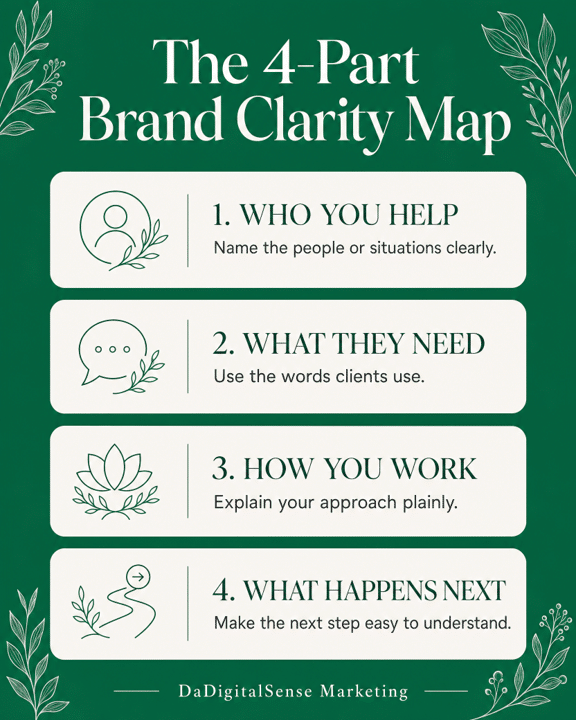
A useful brand story answers four practical questions:
- Who is this for? Name the people or situations you serve with enough specificity that an ideal client can recognize themselves.
- What are they looking for? Use the language clients use when they are seeking support, not only the language used inside your modality.
- What makes your approach distinct? Explain the experience, process, or perspective that sets your practice apart without making inflated health claims.
- What happens next? Let people know how to book, what a first session involves, and what they can expect before they commit.
This is especially important when your modality is less familiar. A person may be interested in hypnotherapy, energy work, somatic support, acupuncture, or functional wellness care without knowing exactly how to evaluate it. Clear messaging lowers that uncertainty. It also gives search engines and AI systems direct language to associate with your practice rather than forcing them to infer meaning from a beautiful but vague website.
The “Beautiful but Unclear” Website Problem
A calm palette, warm photos, thoughtful testimonials, and a sincere mission statement can absolutely belong on a wellness website. They create a feeling. But feeling alone is not enough to help a stranger decide whether they should book.
That is why a website that looks good but does not bring clients often has a messaging problem before it has a traffic problem. The visitor cannot quickly answer basic questions:
“Is this practitioner experienced with the concern I have?”
“Do they work with someone like me?”
“What will actually happen if I reach out?”
When those answers are buried beneath philosophy, credentials, or generic promises, the client leaves to keep searching. Not because your practice is not a fit, but because the path to understanding it required too much effort.
A Simple Messaging Map for Every Core Website Page
You do not need to rewrite your full website in one weekend. Start with the pages that do the most decision-making work: your home page, core service pages, and booking page.
- Lead with the client’s situation
Your opening headline should make it clear who the page is for or what problem the page helps address. It does not have to be clinical or overly narrow.
Instead of:
“A More Balanced Way to Heal”
Try:
“Holistic Support for Adults Navigating Stress, Anxiety, and Persistent Overwhelm”
The second version is still warm. It simply gives the right visitor an immediate reason to keep reading.
- Name your service plainly before adding philosophy
Your philosophy matters. It explains the care and intention behind your work. But it should follow—not replace—a plain-language description of the service.
For example: “I offer clinical hypnotherapy for adults who want support with anxiety, habits, and stress-related patterns. Sessions combine focused therapeutic techniques with a collaborative, client-led approach.”
That statement makes the service understandable. Your philosophy can then explain why your approach is different, how you hold sessions, and what you believe helps clients feel supported.
- Show the path, not only the promise
Clients often delay booking because the process feels unknown. A simple “What to Expect” section can remove more friction than another paragraph about your values.
Explain what happens after someone books, how long the first session is, whether there is an intake form, and how you decide together whether your work is a fit. Clear process language feels respectful because it lets people make an informed choice.
- Repeat the same truth across the places clients check
Your website, service descriptions, Google Business Profile, reviews, social profiles, and booking flow do not need identical wording. They do need to agree on the essentials: what you offer, where you serve, who you help, and what people can expect.
That consistency is part of your AI visibility foundation. It also prevents a common trust leak: a website that says one thing while a profile or directory says something else.
What AI Needs Is Not So Different from What Clients Need
There is a temptation to treat AI visibility as a separate technical project. For most practices, the first improvement is simpler: make your existing story more explicit.
A visitor needs direct answers to questions such as “What do you do?” and “Who do you help?” AI systems also rely on clear, structured public information when they surface a business in response to a question. Neither audience benefits from pages that make them guess.
That does not mean writing for a machine at the expense of your humanity. It means giving your humanity a clear shape. Your point of view, tone, and approach are still what make your practice memorable. The structure simply makes that message easier to understand.
A 20-Minute Brand Alignment Check
Open your home page and read only the headline, the first paragraph, your primary service heading, and the main call to action. Then ask:
- Could a first-time visitor tell who I help without scrolling?
- Could they explain what I offer in one sentence?
- Is my distinct approach stated plainly, without jargon or overpromising?
- Would they know what happens when they click the booking button?
- Does this match what my Google Business Profile and service pages say?
If the answer to any question is “not quite,” you do not need more personality. You need more precision.
Your Website Should Sound Like You—Only Clearer
The goal is not to turn your practice into a generic marketing brand. It is to make the meaning already inside your work visible to the people looking for it.
When your story is clear, the right clients can recognize themselves in it. They can understand your approach, trust the next step, and decide to reach out without being pushed.
Want an outside perspective on whether your website reflects the practice you have actually built? Get your Free Business DNA & Brand Alignment Snapshot